Mythinks #9
The Last Metroid #5 - Metroid Fusion - The Most Nuanced Metroid
It's hardly any secret, at least if you're even tangentially familiar with the Metroid series, that the franchise takes a number of cues from the 1979 Alien film series. We've gone into as much in this very Metroid review marathon. And overall, we would say most of the franchise, especially games that came out before Other M, are fairly consistent with this. A struggle to the death with otherworldly alien creatures and environments, not quite something I personally would call horror, but certainly a tension-building thriller that, like original capital-A Alien, thrives on those quiet moments that are constantly making you second-guess when exactly shit is about to go down.
Metroid Fusion, on the other hand, definitely feels like it's taking more than a few notes from another sci-fi thriller movie, by almost essentially making you fight 1982's The Thing over the course of a whole game. Just made more suited for the far-flung futuristic setting of Metroid than Thing's more down-to-earth setting. Immediately off the bat, you're introduced to the X Parasites, gelatinous amoeba creatures that can infect any living organism and copy its exact genetic makeup, becoming a mutated, sometimes even cross-bred version of any creatures that individual X has come in contact with.
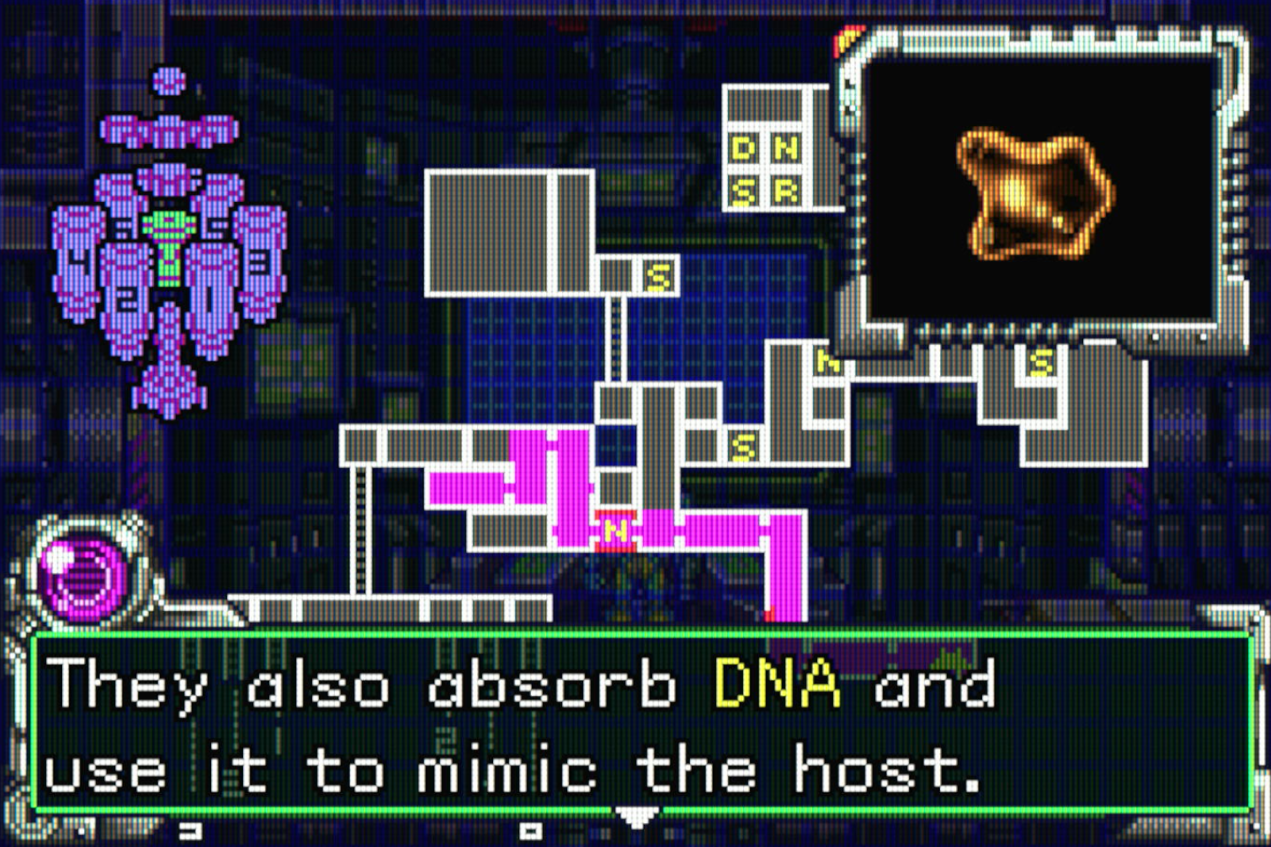
And the similarities don't even stop at that, with how the X also adopt the intelligence of organisms they assimilate, the threat being a little more existential than just "they're gonna kill you", with the "bad end" so to speak being that the infectious doppelganger aliens could, at least in theory, replace all life as they endlessly spread. Stranded on a single facility with said aliens. Mystery hub-bub on if there's even any uninfected humans left in said facility. You get the picture. It just feels funny watching Alien and The Thing within the last few years only to realize how on the nose this feels compared to the series' previous ways it took inspiration from Alien. That is to say, the Metroids were pretty Xenomorph-like, between a face-hugging larval stage and having a queen. But that basically being where the more direct similarities end. Not to say Fusion is inferior with this mode of things, it's at least a little funny.
But what it does feel like it sets up is how the focus shifts a little bit, with this game compared to previous 2D Metroids. Perhaps getting into a little bit of dumb genre semantics, but we don't really consider Alien a "horror" movie, feeling a bit more like an action flick that leans really heavily into suspense. The Thing, however, definitely feels more like it fits the bill for what I expect out of "horror". And through this arbitrary self-labelling, we have decided that it's plenty fitting that Metroid Fusion aims to be a lot more brutal than all other than maybe the original Metroid, which perhaps felt that way more for its archaic elements than anything else.
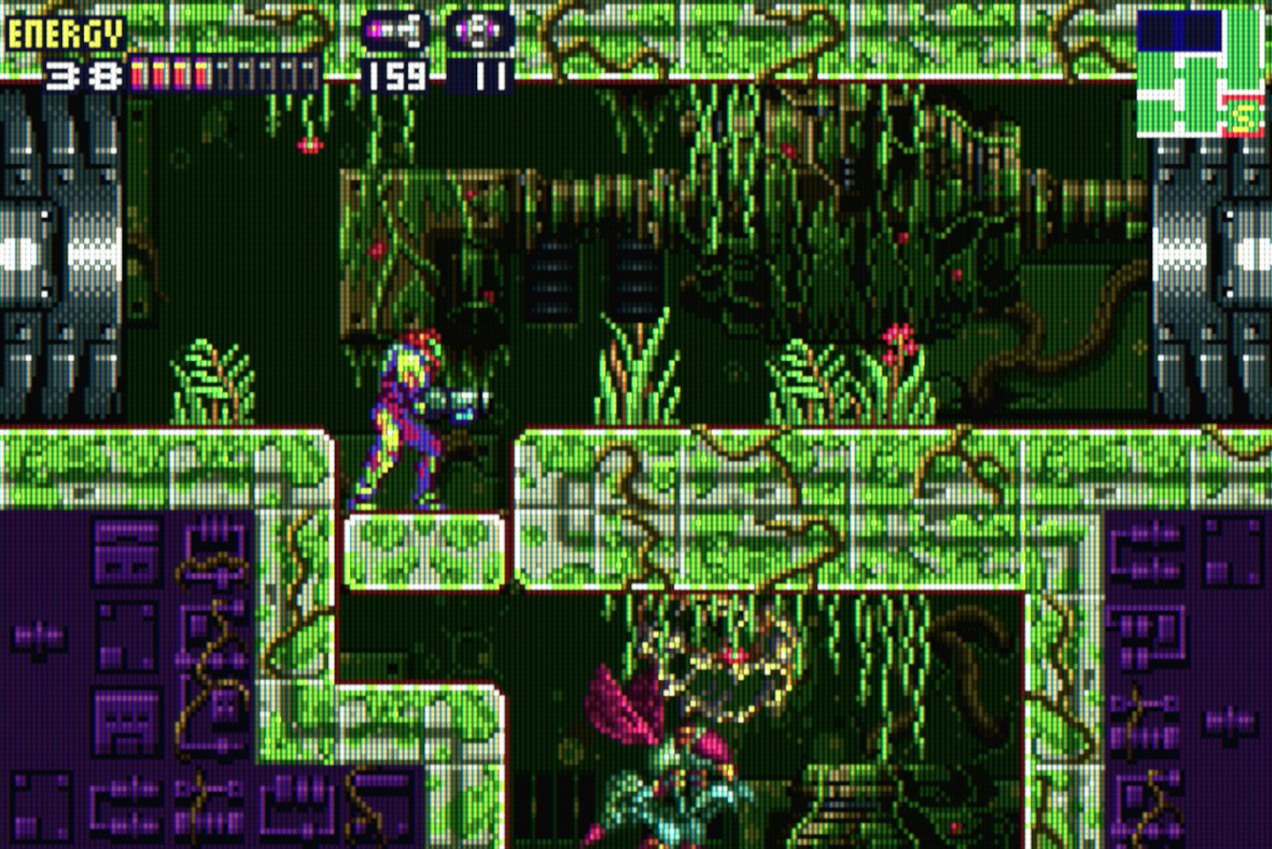
See, Super Metroid wasn't really that difficult. Especially as you picked up more and more suit upgrades. By the end, you're basically a flying, somersaulting tank that can brunt a lot of punishment and, if nothing else, can just out-attrition most of your opponents unless you are particularly careless. Fusion, however, you absolutely cannot afford to play like you're virtually invincible, given how quickly you can just get eaten alive even by basic enemies if you're not careful.
Sure, this done in large part because Samus is far more nimble in this game, having some additions to her basic movement set, having far less floaty jumps, a new ledge-grab, and much snappier controls. Instead of assigning a diagonal to a shoulder button, they're now on just the L button, you just point up or down on the D-Pad to point at which diagonal direction you want to aim. This also frees up the GBA's scant few buttons so that missiles are active when you hold the R shoulder button instead of juggling Super's far more cumbersome selection menu. All moves that definitely give Samus a notable amount more finesse.
 JINX:
JINX:
as such, the game can afford to punish you a lot harder for your own screw-ups, since you have much more exact control over Samus herself now and don't have to stop-and-start as often. and enemies definitely hurt a lot more in this one. some attacks even being able to take off half an energy tank or more. hell, there's even some attacks that deal MULTIPLE ENERGY TANKS in damage. and as if that isn't enough, you don't get traditional health and ammo drops in this one. just the absorbable x parasites that will go out of their way to try and avoid being absorbed by you and even in and of themselves become hazards. that's right, even your health pickups are trying to kill you. all this definitely making Fusion almost play a bit more like a survival-horror game than any previous metroid did.
-------------------------------------------------------
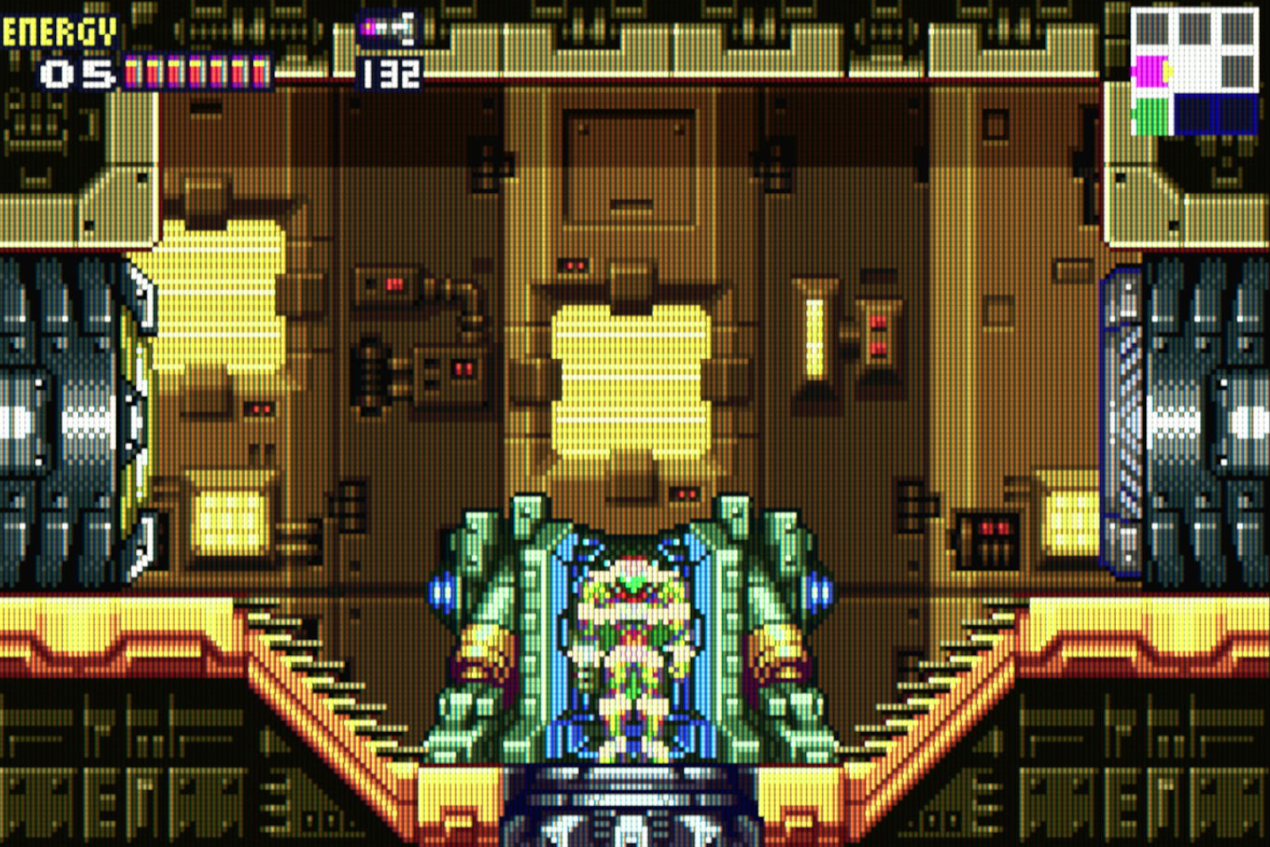
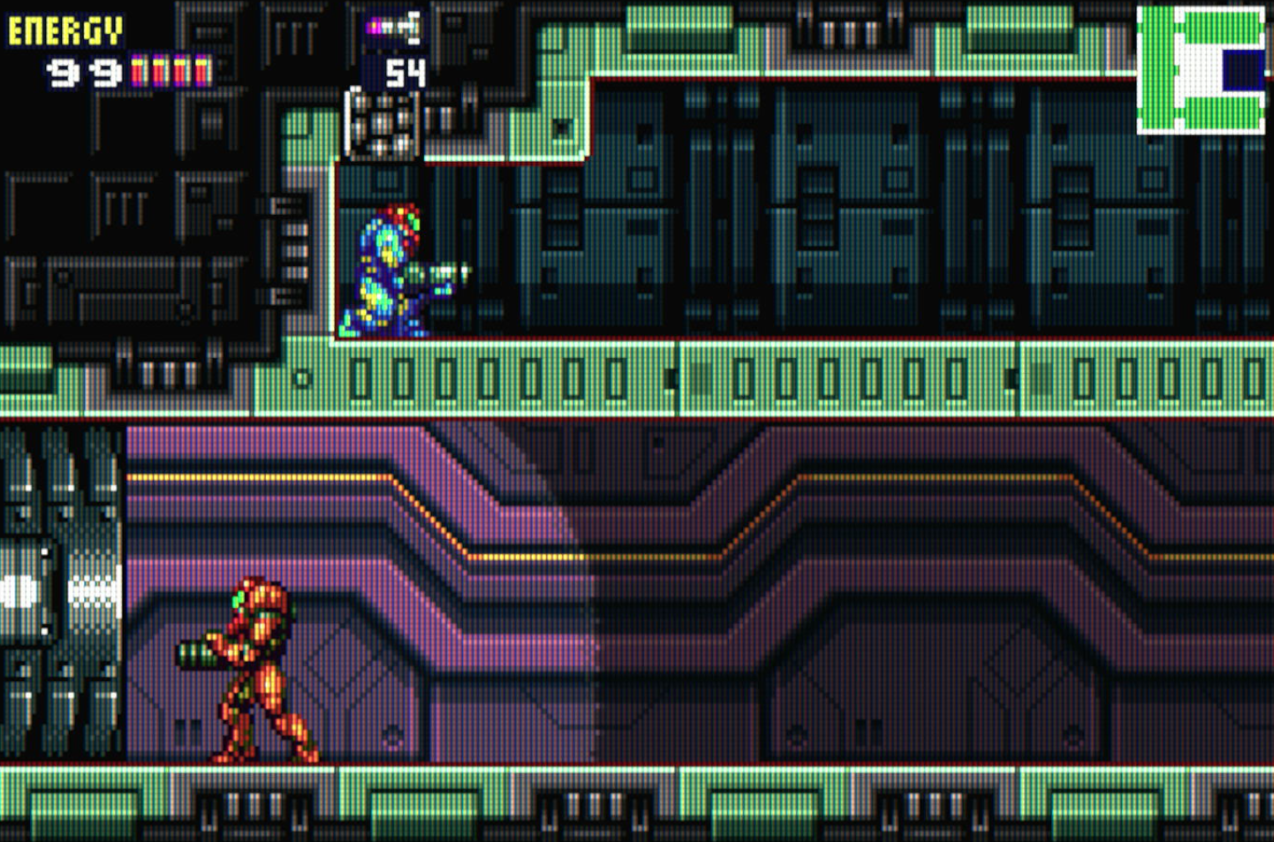
The space between recharge and save stations can be really felt in this one. The game is rarely so rude that a save station is far away from a room that a boss resides in, but the few times that does happen, boy does the game bare its fangs. The stretch between the ship and the giant spider boss, Yakuza (yes, its real name) can be a little brutal, given how much damage the X-Zebesians deal and this segment occurring during a power blackout, so your ship is the only functioning save station at that point. It's not the worst gauntlet in all of Metroid, but it can still leave me at less than full health when trying to fight Yakuza, which is one of the more frustrating fights in the game for me.
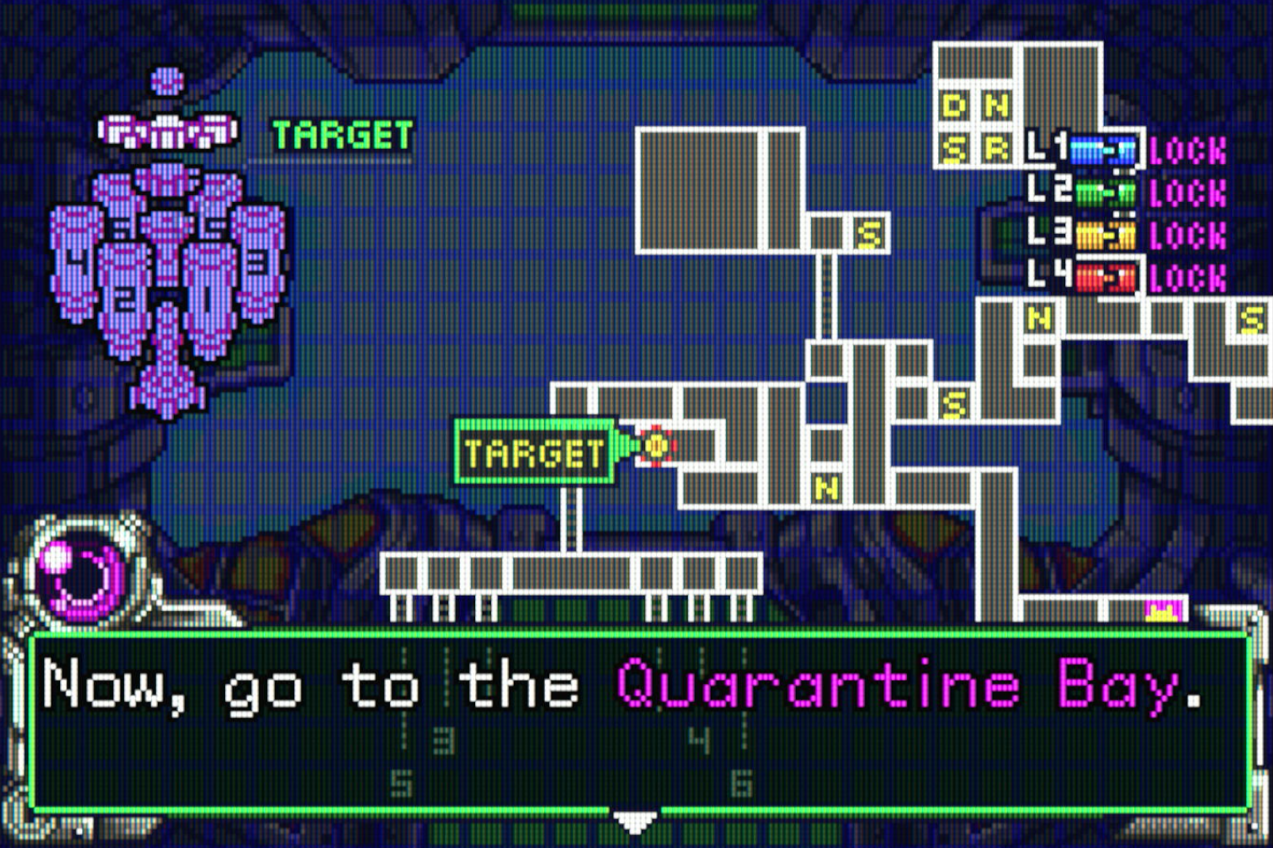
In plenty of ways, this game very much admits that it is not Super Metroid, and could never be Super Metroid. Thus instead, this game almost aims to be its polar opposite in a lot of ways. If you know anything about this game, there's a decent chance that it includes the fact that it's notably more linear and far less free-form than previous Metroid games. Sure, there was an intended item order, and especially in Metroid 2, all the Metroid games are linear to SOME extent, but in Super Metroid you could just break the sequence and get a few upgrades early here and there, and you were even encouraged to. Fusion not so much.
Fusion, by contrast, is a game very often sticking objective markers on your map, has a lot more sequence-based setpieces, and will have events occur that are part of the more linear story progression. And I'm of two minds about this. There is of course the common gamer take that linearity = bad, which I very much disagree with. Especially if sticking linearity in a genre usually known for being open-ended has a point to it, which Fusion very much does.
This time around, the entire game takes place on a huge Galactic Federation space station, Samus being sent there to investigate what's supposed to be a simple confirmation on what in the station exploded and why the station's crew hasn't sent a message in a while, before it turns out something in the containment bay exploded, releasing captured samples of X-infected lifeforms onto the station and causing them to overrun said station. Given you spend the entire game on Federation property, it would make sense why they guide you around the place with a very, very heavy hand as they control your pace the entire way.
They even assign Samus' ship and AI companion. Not that kind. It's a 2002 game, y'know what I mean. Back before "artificial intelligence" got hijacked as a fancy-shmancy buzzword to make it sound like we're developing technology that's smarter than it actually is. Sigh. Anyway, they assigned an AI to watch over and give Samus directions, which is in very stark contrast to every other Metroid that just plopped you into the middle of an open-ended world and expected you to find your own way around, even if it meant you got lost.
 CELESTE:
In fact, this game is so dead-set on keeping you on this set, linear track, that it's much, much, much harder to sequence break. They went out of their way to remove sequence-breaking tricks like wall-jumping off the same wall over and over, and offsetting the timing on morph ball bomb detonations so that infinite bomb-jumping is impossible. It's a game where you are a lot more limited in where you can go and what you can do at a given point in the story, very often getting thrown into a linear sequence with only one way out. And given what we'll get into when we go over the plot, there very much is a point to the Federation keeping Samus on a leash as much as they possibly can.
-------------------------------------------------------
 VIXI:
VIXI:
My feelings get a bit more complicated with the moments where the game goes "off-script". That is to say, you'll defeat a boss, complete an objective, acquire a new item, but the task of "get back to a Navigation Room to talk to the AI" is more complicated than simply turning around and going back the way you came. Or is it? They play with this a little bit near the beginning, but by the end the points of no return force Samus to go further and further off the cuff, eventually to a point where she's forced to open up the most restricted-security door type, and access more restricted areas. A fair enough narrative arc, given you've been playing the game under the Federation's thumb the whole time. But it's still very much "on-script".
Like, from a narrative beat perspective, I get it. The aquarium section of the game is definitely a point where hands are off and it's up to you to find a way out of the area with no guidance whatsoever. But at the same time, you don't really have a choice but to open the level 4 security hatches. It's the only way to progress the story, still. Hell, there's even a way out of this segment without opening the security doors, but it's so difficult that the devs put a cute message at the next Nav room you enter for you to turn back and complete the task as intended. Which just muddies the point, a bit. Are these off-script moments meant to be the player reclaiming some of their Super Metroid-given freedom back or not?
-------------------------------------------------------
 LUNA:
LUNA:
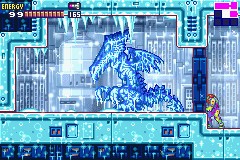
One moment that always stuck with me when first playing this game is being able to ender a cryo-chamber in the main sector. Normally, you can't really enter this room until you have the Varia suit, but you can nonetheless enter it to see the frozen, preserved corpse of what was once Ridley being kept in storage. And this moment actually is optional, even minding the point where you have no choice but to stumble into it. You can discover it much earlier than "intended" if you're nosy enough. And I really wish there was more of that in this game that drives the point home better.
-------------------------------------------------------
It's still a fun enough linear adventure, mind you. Again, it's not like those are inherently bad, but more than once I have heard people run defense of Fusion by saying "it tricks you into thinking it's a purely linear game, but then you can go off-script and mess up the Federation operation". Except these moments are still keeping you on a leash, it's just invisible now. But, whatever, Metroidvania games are all just ventures to disguise how linear they actually are, I guess.
At any rate, there is eventually a point where you get your last major upgrade and suddenly the whole station just cracks wide open and you can finally explore it to its full contents and there's nothing the Federation can do to stop you. But this, naturally, happens at the very end of the game where all there's left to do is pick up the items in order to 100% the game. Which also stinks because it feels like most of what I'm grabbing is actually Power Bombs, the least useful of the powerups. At least if you're vigilant to remember where all the energy and missile packs are to be picking them up when you can get them on the way. Like, seriously? Who needs 72 Power Bombs? Power Bombs Georg? Everyone knows he doesn't count!
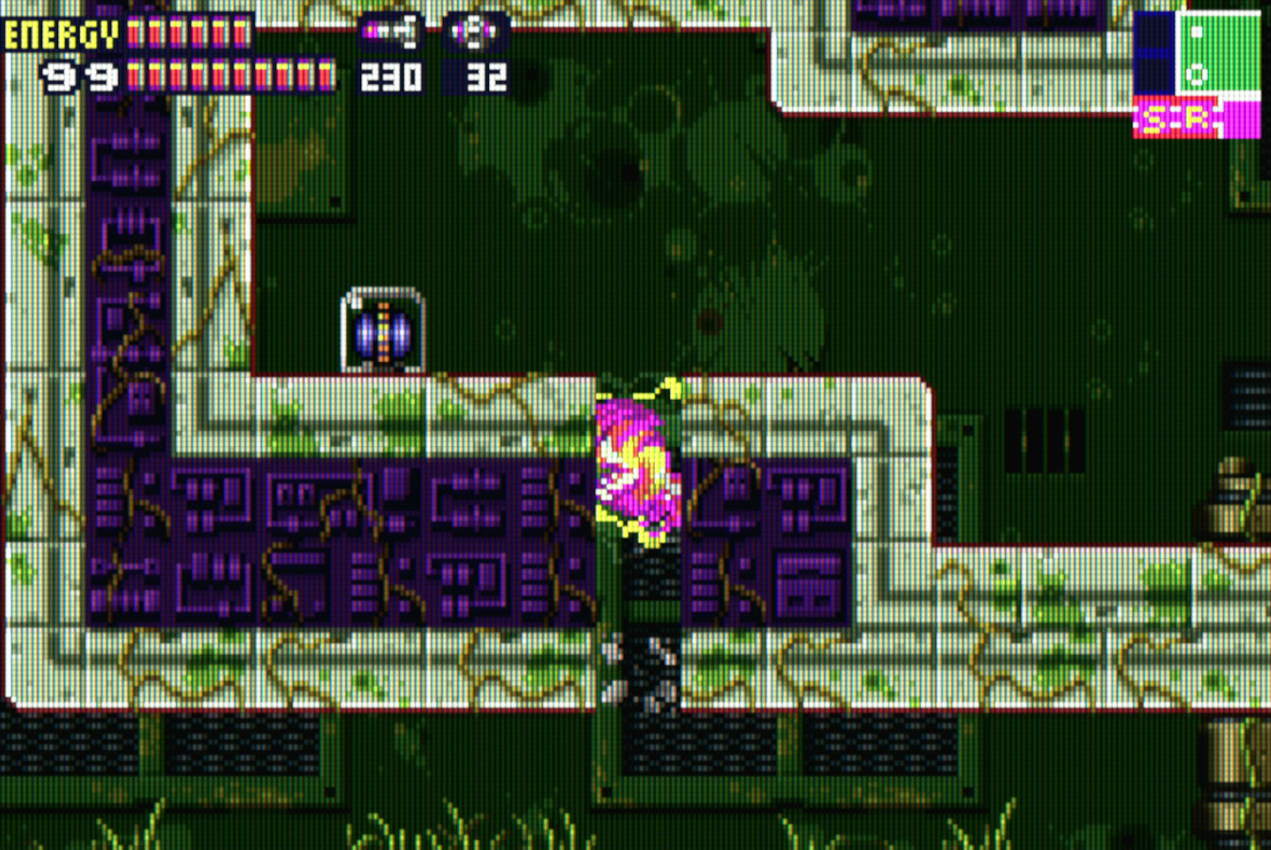
This point is just especially bothersome because to me cause it really does feel like this Metroid is the best set up to be a straight-simple speedrun game, except I would also like to collect all the items while also going fast. But then this victory lap around the station happens and it just makes things a bit of a pain. I'll still do a lap but then it turns out I missed a Power Bomb somewhere and at that point I don't wanna run around trying to remember where I missed something. Which is a sentiment I feel like I shouldn't be having in a genre where the whole point is collecting stuff. Maybe it's just because I've replayed Super and Prime 1 so many times that having a decently satisfactory route through the game is somewhat effortless to me, but I dunno. 100% collection is usually its own reward to me but bluh. Bluhhh.
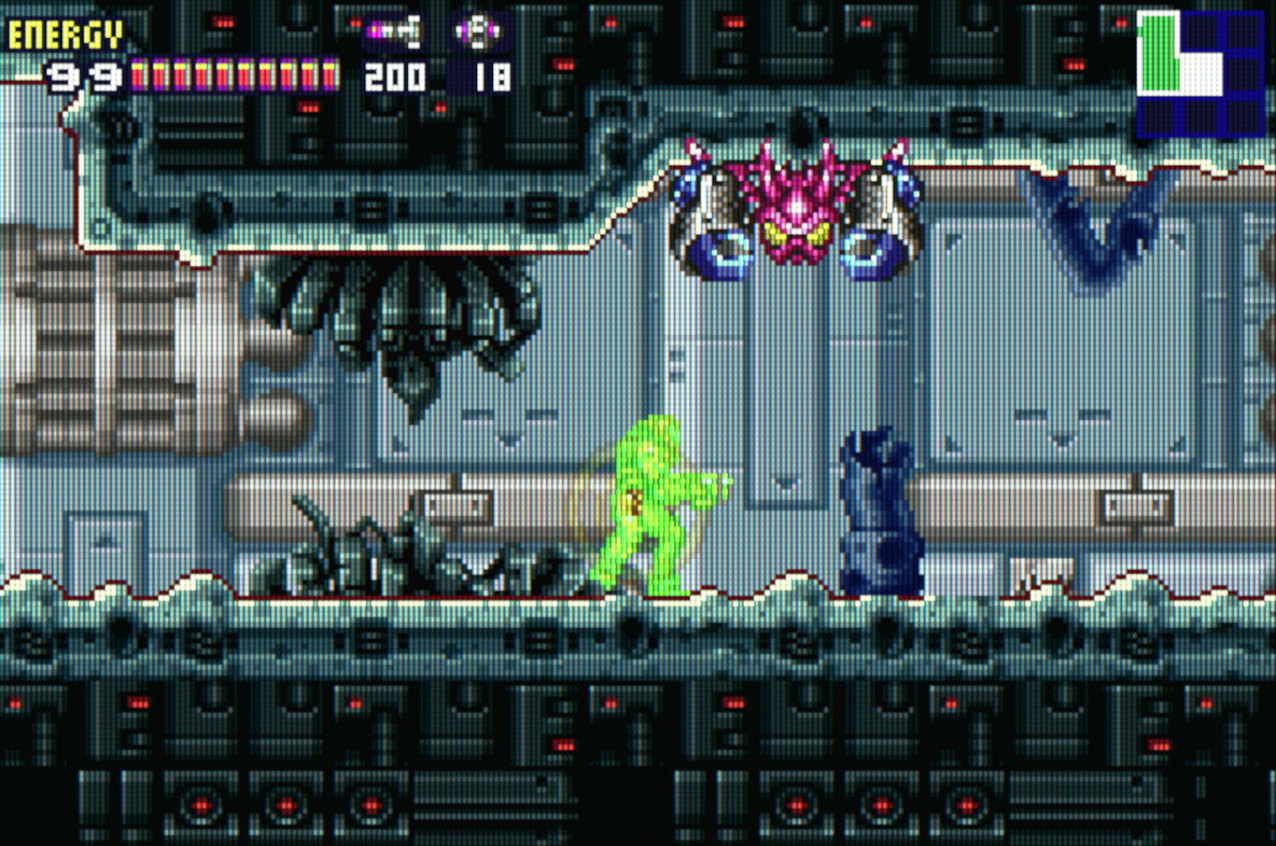
Fusion does at the very least make the most out of being linear. A lot of areas permanently change, some doors get permanently ruined and no longer passable, the frozen section of ARC gets ruined to the point where all the ice melts, you'll see larvae eventually pupate and then emerge as Kihunters. There's lots of tiny changing details in the environment over the course of the game.
Though as long as we're getting into some presentation things, it feels worthwhile to bring up that this is the first Metroid that I feel like has a bit of a weak soundtrack. Which, I know is rich coming from the sick freak that defended Metroid 2's lack thereof, but I don't find Fusion's music that good to just listen to outside of their original contexts, let alone the contexts they're in where they come off as droning, not in a creepy way but in a kinda weak and meandering way. That and all but one of the boss themes just sound sillier than they aught to be for dramatic encounters against freakish shapeshifting aliens. The AQA tracks are nice, at least.
That isn't to say Fusion isn't satisfying to explore just as a Metroidvania, it's still littered with plenty of secret nooks and crannies and certainly feels like the Metroid with the most individual pickups in it so far in this series. If you can remember where things are, it can be gratifying to just swoop into a room, grab two, sometimes even three pickups, and swoop out again to continue on. That much is at the very least satisfying. And this game can have bizarrely complicated puzzles, too, with a lot of tests for how well to use your abilities, especially the expanded Shinespark capabilities. Speaking of which...
...Yes, that's our segway into the items section.
-------------------------------------------------------
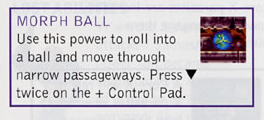
Morph Ball:
Still good ol' Morph Ball. But a decent enough difference this time around is the way it interacts with Samus' new innate ledge-grabbing ability. She can actually grab a tile-wide hole that's off of ground and pull herself into it, immediately going into Morph Ball in the process. Neat!

Charge Beam:
Charge Beam this time around actually has an effect on your normal firing beam, making the shot ever so slightly wider and a bit more forgiving. Though to my observation, it feels like the shot also gets divided into two if it barely clips an enemy.
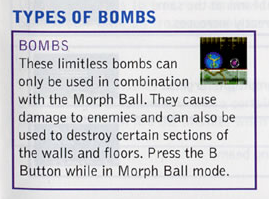
Bombs:
As stated, the main difference between then and now with Morph Ball Bombs is that infinite bomb jumping is no longer possible. Get ready to see this point go back and forth with the 2D games.
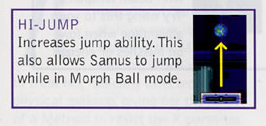
Hi-Jump and Jump Ball:
Gotten as a two-package deal in this game in particular, they. Both do what they usually do. It's just nifty to have Jump Ball so early this time around.
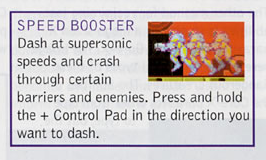
Speed Booster:
With the limited GBA button economy, you now simply have to run for an extended amount of time to start speed-boosting. Shinespark is also tweaked a bit, no longer taking energy to use nor does it deal damage to you on impact, now. Also a new mechanic is that if you shinespark into a slope, it'll put you back into the speed-boosting running state, allowing you to carry your speed boost up and up and up. Though this is mostly just used for little challenge rooms.

Super Missiles:
Instead of being a distinct type of shot with its own ammo type, Super Missiles are now a straight upgrade on your base missiles, tripling their damage. Maybe the dynamic is less interesting this way, but it's probably best just given the GBA's limited button count.
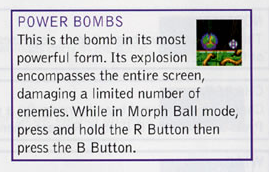
Power Bombs:
Power Bomb overall just feels a little less useful in this one. It doesn't seem to be a screen-wide block reveal like it used to, but it DOES have a suction effect on any nearby free-floating X parasites, drawing them in and making them easier to absorb. So there's that.
New!

Ice Missiles:
Apparently being infused with Metroid DNA makes it so Samus cannot have the Ice Beam installed ever again, and thus the ice effect has to be given as another augment to the missiles. They're missiles, but they freeze things. Perhaps nice to have Ice Beam's effect be more of a purposeful action than something you innately have that makes some enemies take two shots to kill.
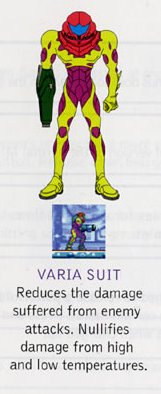
Varia Suit:
Same as it usually does. But with a twist! Since Samus is part Metroid now, she's a lot more weak to the cold. I mean, most people are, but I guess even her suit's basic insulation can't protect her, or something. As such Varia Suit now has the added functionality of making you able to enter super-cold areas as well as super-hot. The only trade-off is it's now a fugly green for a later-coming reason.
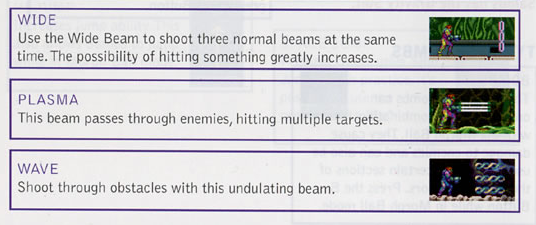
Wide, Plasma, and Wave Beams:
Lumped together because they largely behave the same as they do in Super Metroid. But each beam does feel like a substantial uptick in damage output. And like stated with Ice Missiles, Ice Beam is absent. Or is it.
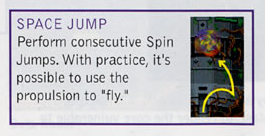
Space Jump:
Mainly notable because Space Jump is decently functional in this one! Mostly! It's still not perfect, but the timing feels a lot more natural in this one, as well as just feeling like it just has a lot more let instead of feeling like the game drops you like a brick for the crime of not pinning down perfect timing over and over and over.
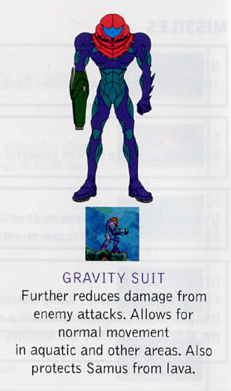
Gravity Suit:
Thankfully still purple.
New!
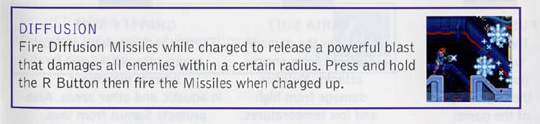
Diffusion Missiles:
With this, Missiles can now be charged like a beam, and if fired after being fully charged, will release a huge AoE attack that freezes everything. A neat idea! Not used for much, especially not in any mandatory room.
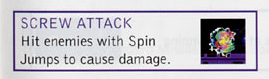
Screw Attack:
Your key to freedom.
...Sadly not much going on in the new ideas department. It definitely remixes a number of old abilities, but this is very much the point where Metroid games start settling into the same fistful of powers that are in every game. Which just feels odd with this game for how much it poises itself as the antithesis to Super Metroid. The yin to its yang.
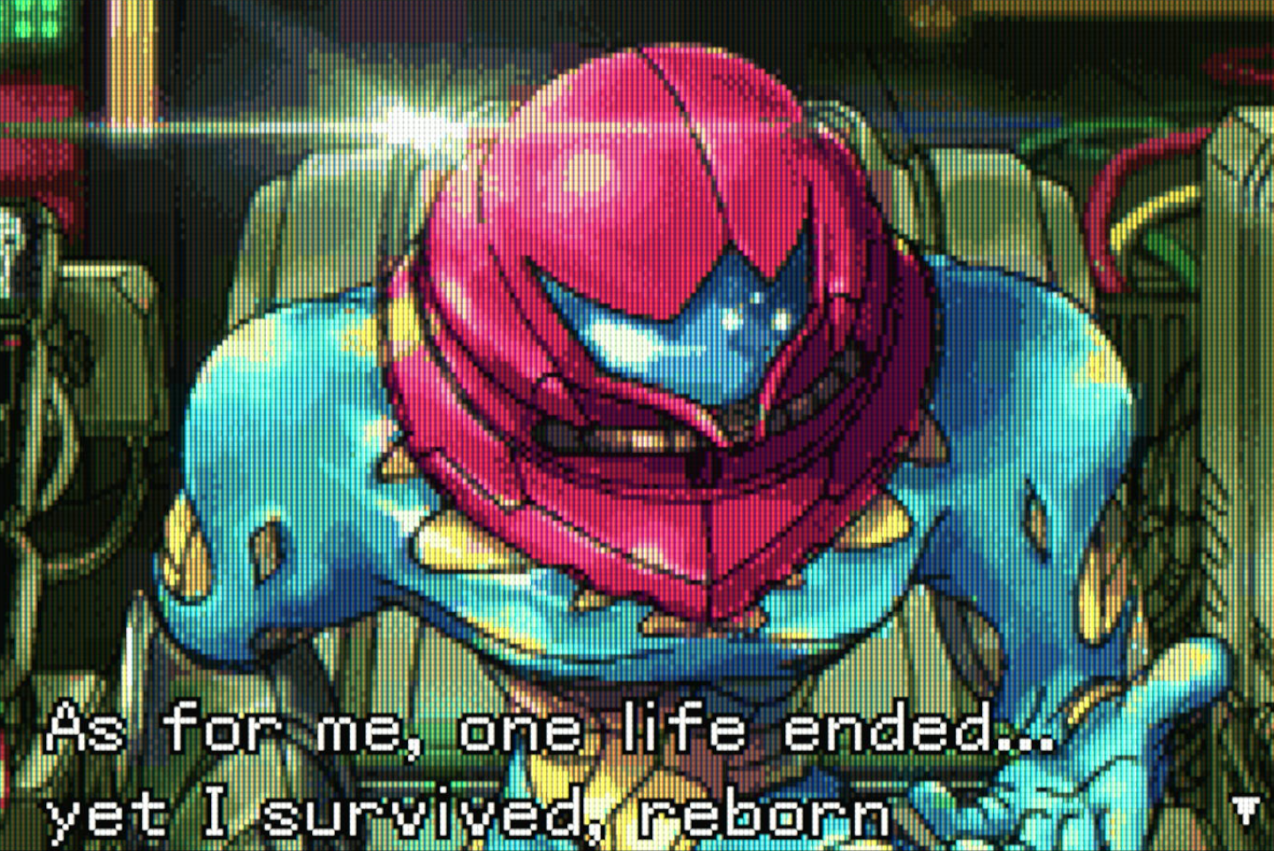
Samus herself is a far more vulnerable character here, starting off a mission as routine as investigating a strange lifeform before it suddenly morphs into a gelatinous slime and enters her body, then leaving her near-death and infected with the X Parasite as it begins taking ahold of her body. She ends up surviving the endeavor by being genetically altered with traces of Metroid DNA from the hatchling, making her part-Metroid and giving her the ability to absorb the X Parasites like a Metroid would.
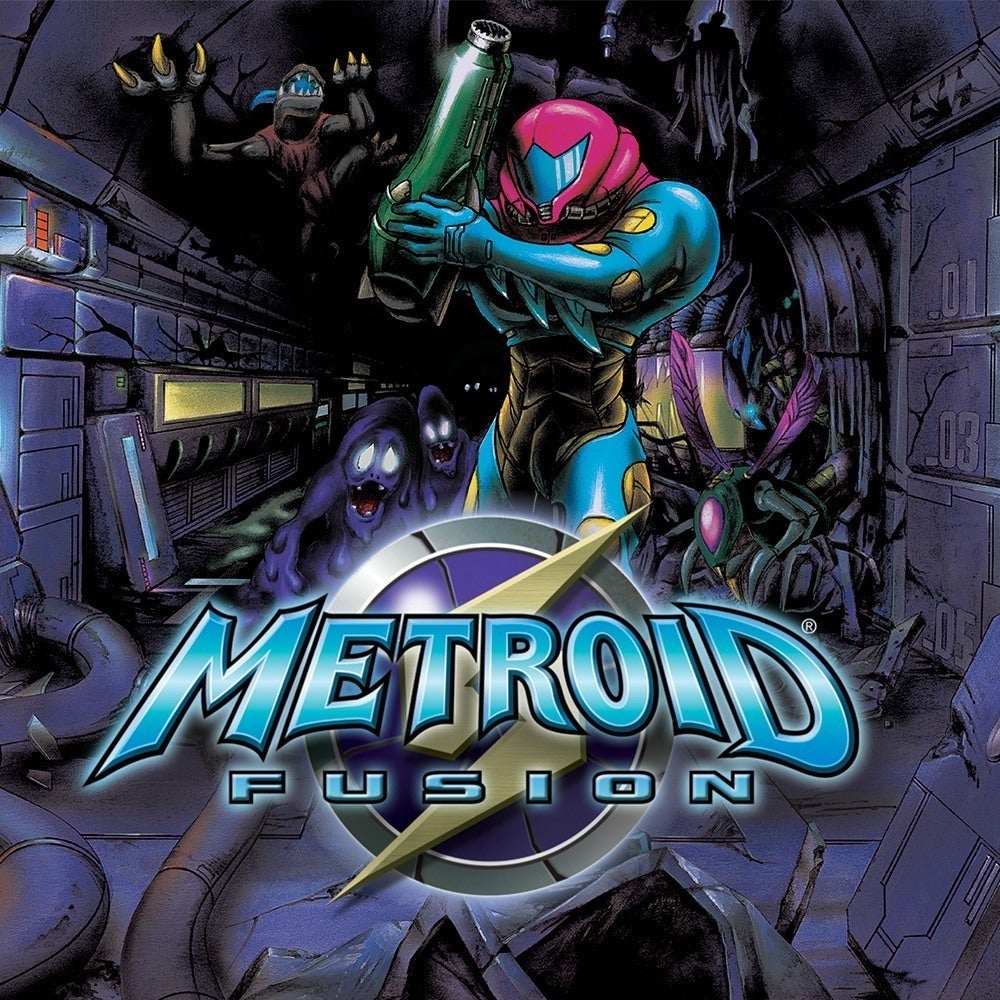
This doesn't leave her unscathed, though, as her suit had begun to fuse to her body thanks to the X Parasite, it had to have its outermost components surgically removed, leaving the blue, muscle-like inner suit. And if nothing else, the design of this suit sets the overall tone for what Metroid Fusion is like. Samus is leaner, a bit more obviously muscular and flexible, but definitely a lot more fragile-looking than the big, walking bomb bunker that was her former suit. The Fusion Suit definitely gives the air that this is a very different experience from previous Metroid games, as well as give a reason for why she takes so much god dang damage now.
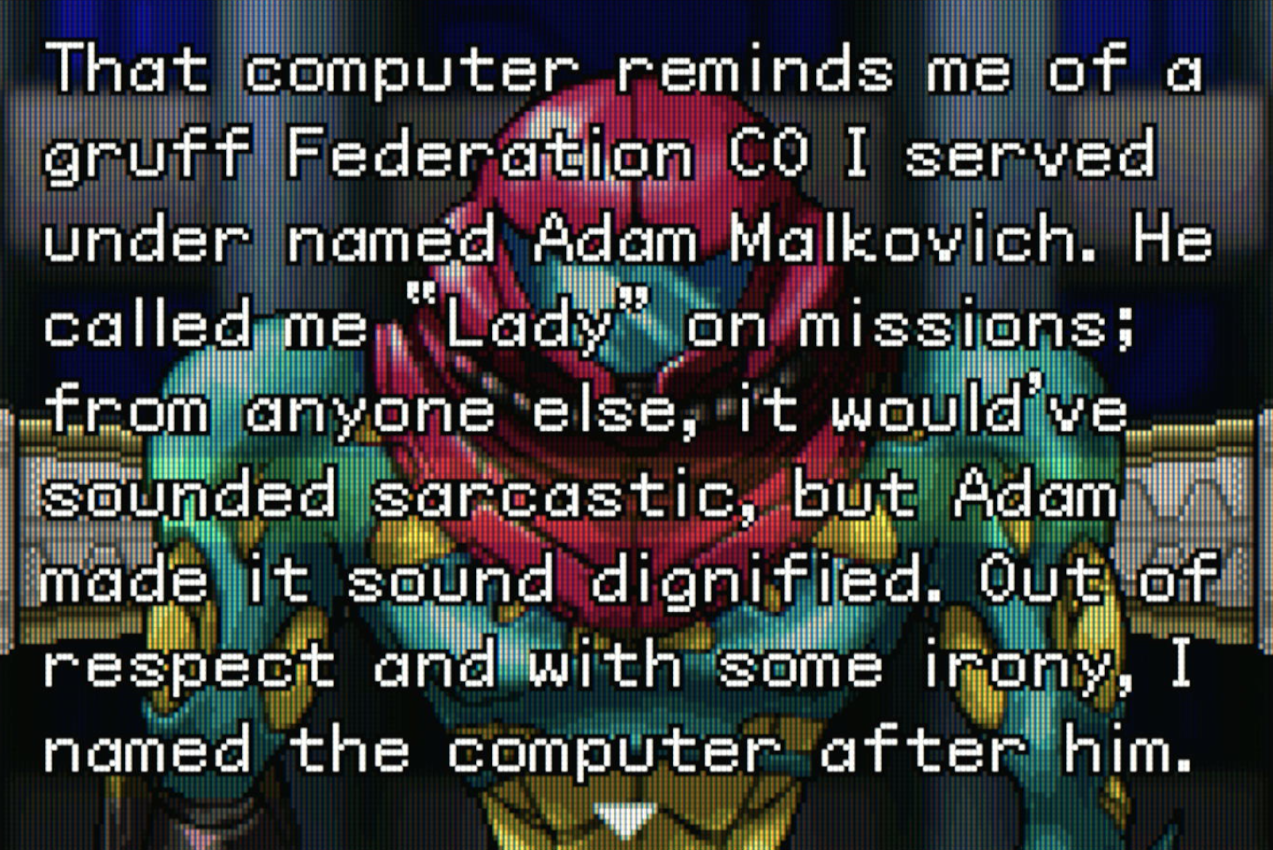
This is also easily the first Metroid that has an explicitly told story as a focal point. Each one so far has varying degrees of plot and, in Prime's case, a backstory explaining what went down on the planet. But this one is regularly carried with monologs, both from the AI that Samus nicknames "Adam" after an old CO of hers, and Samus herself at a few points. As opposed to Super, which had an opening narration recapping the events so far in the series from Samus' point of view. For most of the game, it's in the form of receiving instructions from Adam, but there are various plot developments about the X and Federation as well.
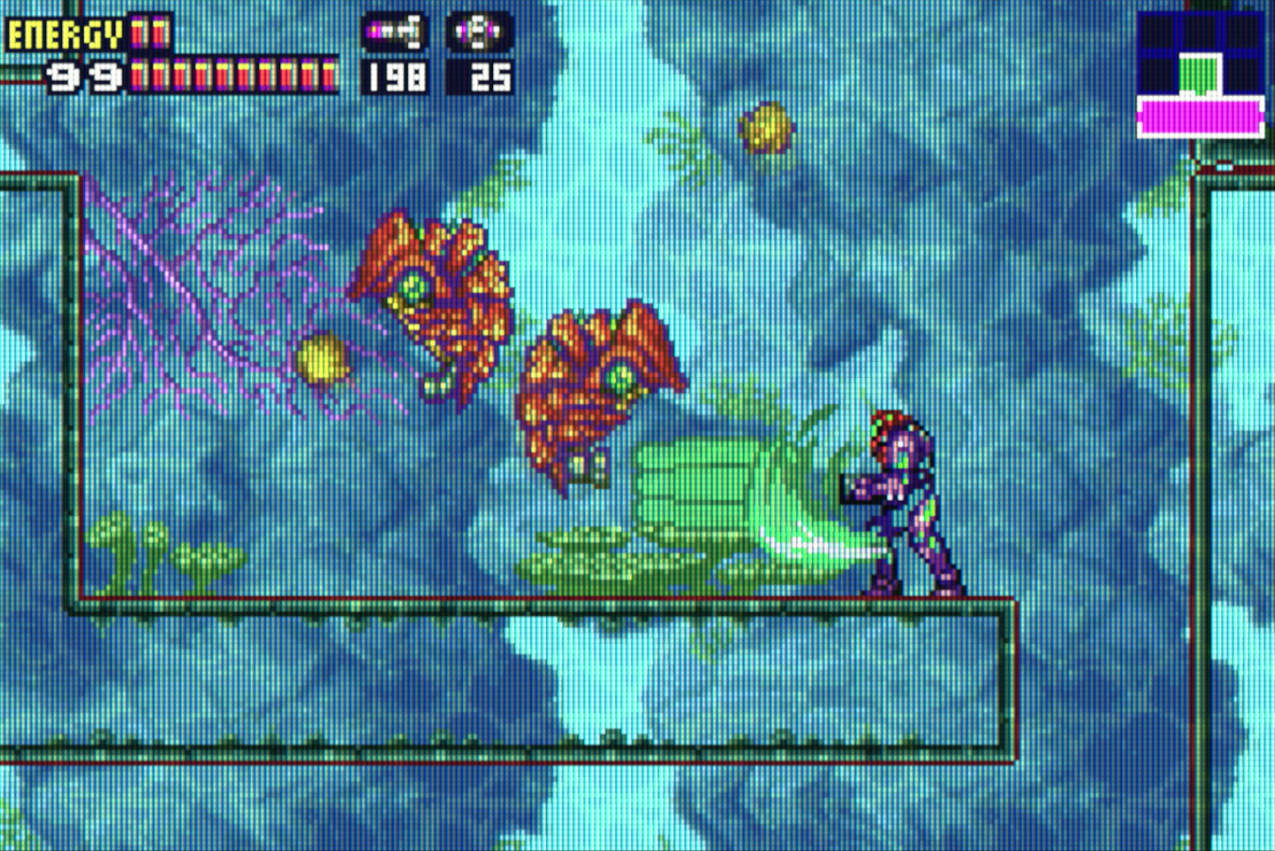
This is very much a game that has its pace dictated to you by the Galactic Federation itself. As much as the BSL station you're exploring is built to replicate real environments, in particular the environments of SR-388, there's still very much the underlying and ever-visible metal from of the station itself about everywhere you look, reminding you you're in a man-made environment. Even the water level in this game is a massive, glass aquarium. Which all this definitely feels like an appropriate setting for the way they try to elicit the feeling that the Federation is keeping their eyes on your every move, especially with Adam remarking whenever you regain an unexpected ability from absorbing an X Parasite and scolding you after those "off-script" moments.
Which, the feeling of being watched and followed is certainly a recurring theme in this game in particular, with the SA-X, the parasite that initially infected Samus and took control of her discarded suit that's now at full power, hounding you all across this station. At least in theory.
The SA-X comes in two parts for me. The expectation and the reality of it. And maybe I just have the benefit of only playing this game as an adult. Or, un-benefit, depending on how you see it. But I've never really found the SA-X that scary. Like, at all.
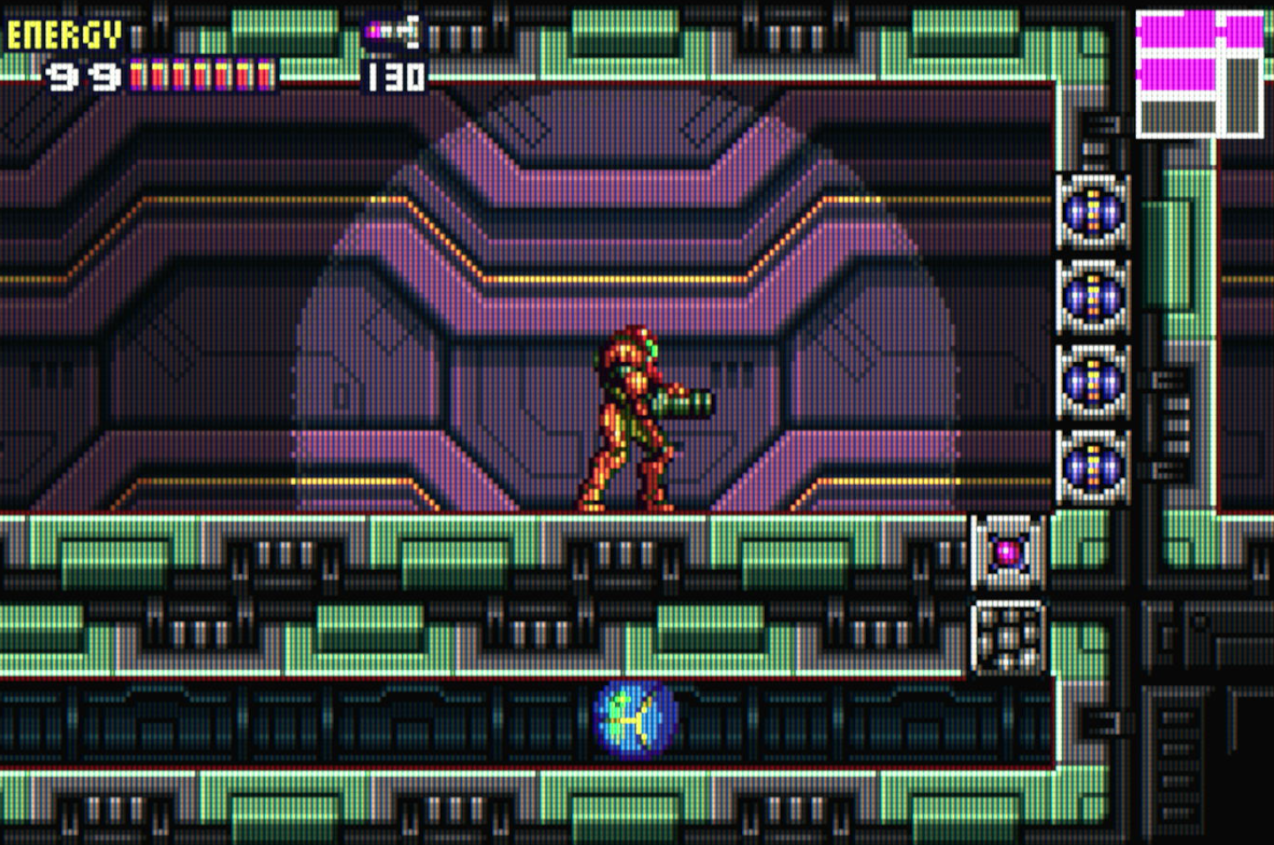
The expectation of the SA-X, what's stated in the text of the game and the way Adam talks about it makes it sound like you're going to meet up with it by chance and have to out-maneuver it to escape it. You're being actively hunted by an intelligent but heartless creature that is you, but far more powerful and far more dangerous. At any moment it could turn up and ruin your day. And sure, on a blind playthrough like my first playthrough, I never quite new when exactly it was going to turn up.
But what pulls so much of the SA-X's teeth is the fact that your encounters with it are NOT by chance. This is not a Mr. X sort of situation where you could encounter it literally anywhere, no matter how inconvenient it'd be for you. It was not at all hard for me to clock that the SA-X only ever appeared for scripted segments, which just inherently means I'm only ever going to encounter it in a controlled environment. Naturally, this only becoming even more obvious when I inevitably die to the SA-X and encounter it in the exact same situation as before. And given how the SA-X can take you from full health to dead in a matter of seconds, replaced any semblance of fear with just frustration.
 IONO:
IONO:
This getting especially bad during the segment after you just acquire the Space Jump where they repeatedly "gotcha" you several times in a row, between you having no choice but to fumble into the room the SA-X is in, having to slip past it somehow, only to encounter a wall that killed me more than a few times because my first thought was "how can a power bomb go off in time to get you away from it?" And it gets comical when they talk SA-X up like there's more than 10 aboard the station, but they must be particularly good at avoiding me given I've done a lap around the whole station at the point this gets mentioned, and didn't see a single one.
-------------------------------------------------------
 VIXI:
VIXI:
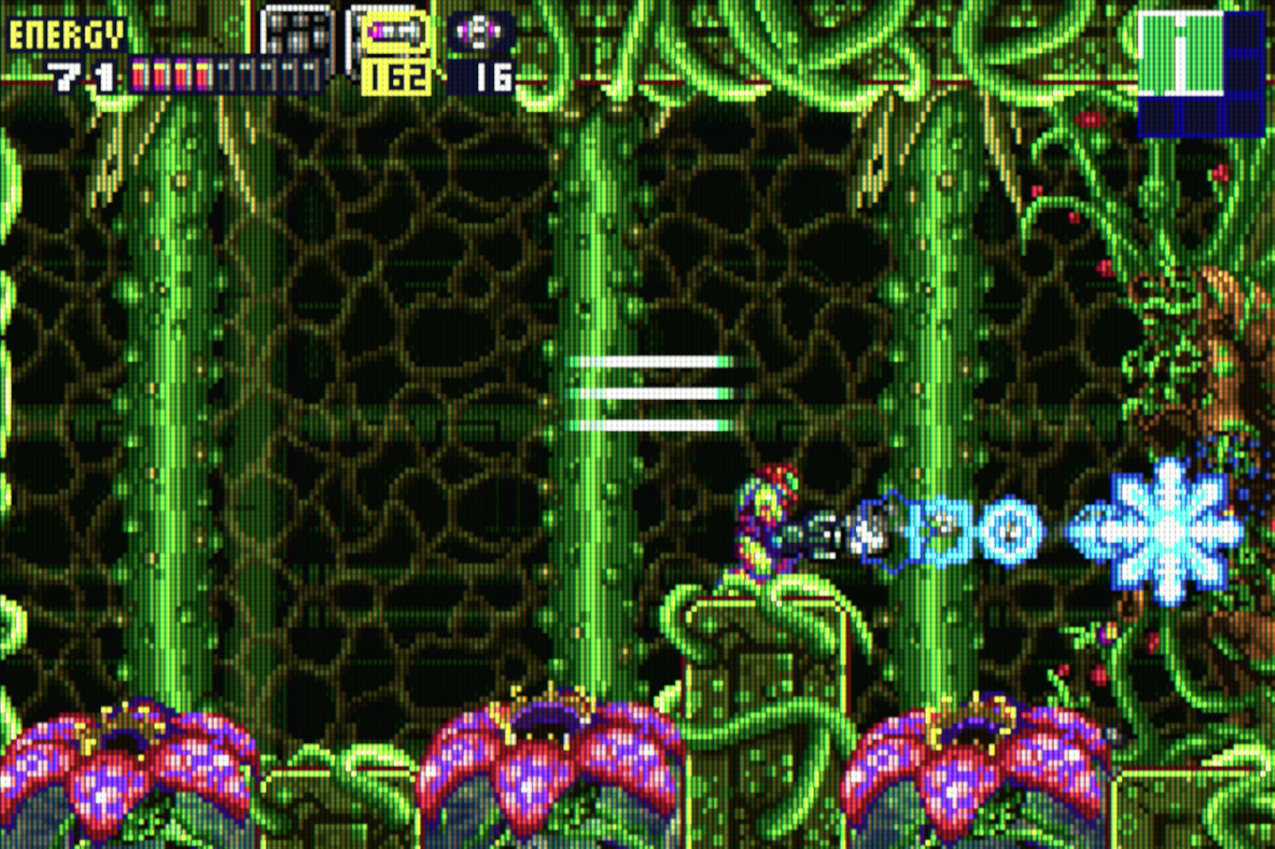
And, obviously all this is subjective, but getting into a bit of self-armchair-psychology here, but I think something some horror games don't entirely understand when they make an invincible murder antagonist like the SA-X is that, as much as the phrase was memed not too long ago, there actually is SOME amount of comfort in total helplessness, if nothing else because it limits your options to just trying to get away and there's no more gymnastics to it, and it makes the encounters with these kind of scripted-sequence-only horror monsters that you can't actually stop, only get away from, very inflexible.
-------------------------------------------------------
I at the very least recall the main monster from Amnesia: The Bunker, granting this was a game that came out two decades later on far more advanced hardware than a GBA, that while you could never permanently get rid of the monster, you COULD have moments where you stand your ground against it and temporarily cause it to retreat. Whereas here, the best you can do to slow the SA-X down or avoid it is use an Ice Missile to freeze it for like, half a second. It's a "can you survive an encounter with this thing" question that makes horror monsters in media actually able to build tension, and it just feels a little boring when the resounding answer to that question is just a flat "no."
Maybe all this is just a product of this being my fifth or sixth playthrough for Fusion, and thus I just grow tired of the SA-X's company more than I'm unnerved with it because I'm just TOO familiar with it at this point, and familiarity makes anything far, far less scary. Just at the same time, I don't remember ever once being afraid of this thing, sadly. Which like, from the standpoint of just enjoying the game, isn't a huge deal, because you spend so little time actually interacting with the thing on a grand scale, but I can't be THAT faulted for thinking a cool idea for a monster isn't explored as much in the actual gameplay itself, right?
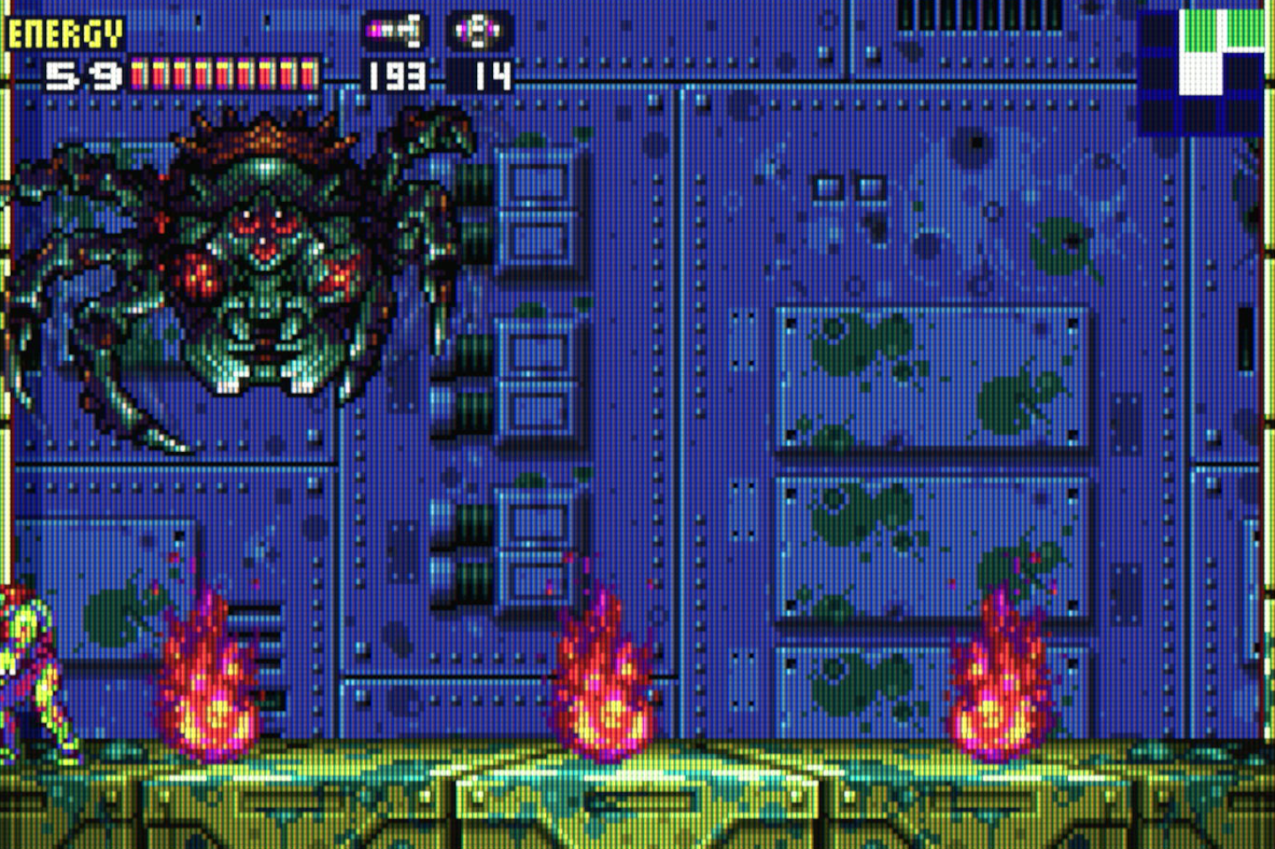
In general this game almost feels a little determined to undermine its own, more dire tone. Some of the music is weirdly goofy, a few of the bosses still hold onto that Super Metroid problem where they're just swinging a half-screen-sized hurtbox around at mach speed, and then you got Yakuza here that becomes a beheaded, flying spider that rapidly spins around in order to stay afloat in the air as if that doesn't look utterly ridiculous. Nightmare's face melting sounds horrible until you see what its melting face looks like. Not that Metroid has to be deathly serious at all times, but this is almost the goofiest a Metroid game looks sometimes.
Either way, SA-X pales in comparison to the game's true antagonist, the Federation itself. Which feels like a bold move given this is among the first games to really cement the modern conception of the Galactic Federation. The GF has been around since the beginning, obviously, but they've always been a background element or framing device that gives Samus a mission to do and little else. Here, they're very much the focal point for the first time, which only solidifies them as the "human" faction in a wider galactic civilization, a conception of them that'll remain consistent for the remainder of the series at this point.
This game's setting almost in and of itself feels like a postmortem of the Metroid setting up to this point. At least barring Prime since that was made by another studio, and also happened to release on the exact same day as this game, so the Fusion team probably weren't directly aware of what they were working on. The Metroids are all extinct, the space pirates have been dealt with, Ridley and Mother Brain are both permanently dead this time, this was well before the Chozo started to be anything more than the mysterious, dead civilization, and Samus has gone and blown up Zebes on top of things. Basically all that there is left is the Federation and these new X Parasites.
Except a lot of what the Federation does on this station, or is at least implied to be doing on this station is very sketch. If this is a station meant to be studying the wildlife of various planets, what are Zebesian Space Pirates doing here? Or Ridley's popsicled corpse? Or the fact that they have a couple bioweapons just lying around wreaking havoc with no masters around to stop them? One of them employing a brain-like bio-mechanical supercomputer not unlike Mother Brain.
It definitely feels more than deliberate that a lot of this game is older elements from the series coming back to haunt Samus now that she's in the most vulnerable state she's been in, which in and of itself feels like a thematic follow-up to Samus' actions on her previous SR-388 adventure in Metroid 2. Had she not gone through with making all but a single Metroid, the natural predators of the X Parasites, extinct, this is very much her previous actions coming back to bite her as hard as possible. But also in turn, her mercy toward the Metroid hatchling coming back to save her when an X parasite would have ended up just assimilating her.
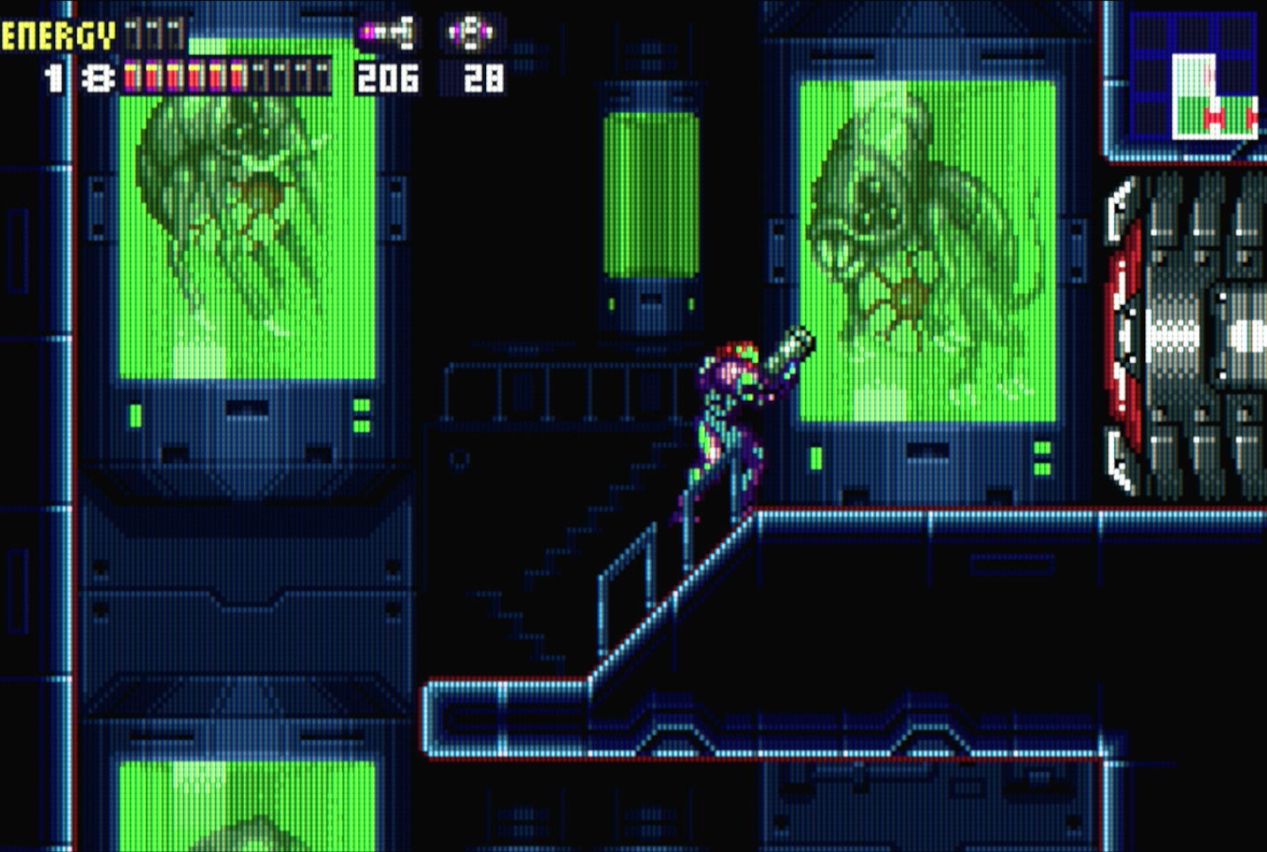
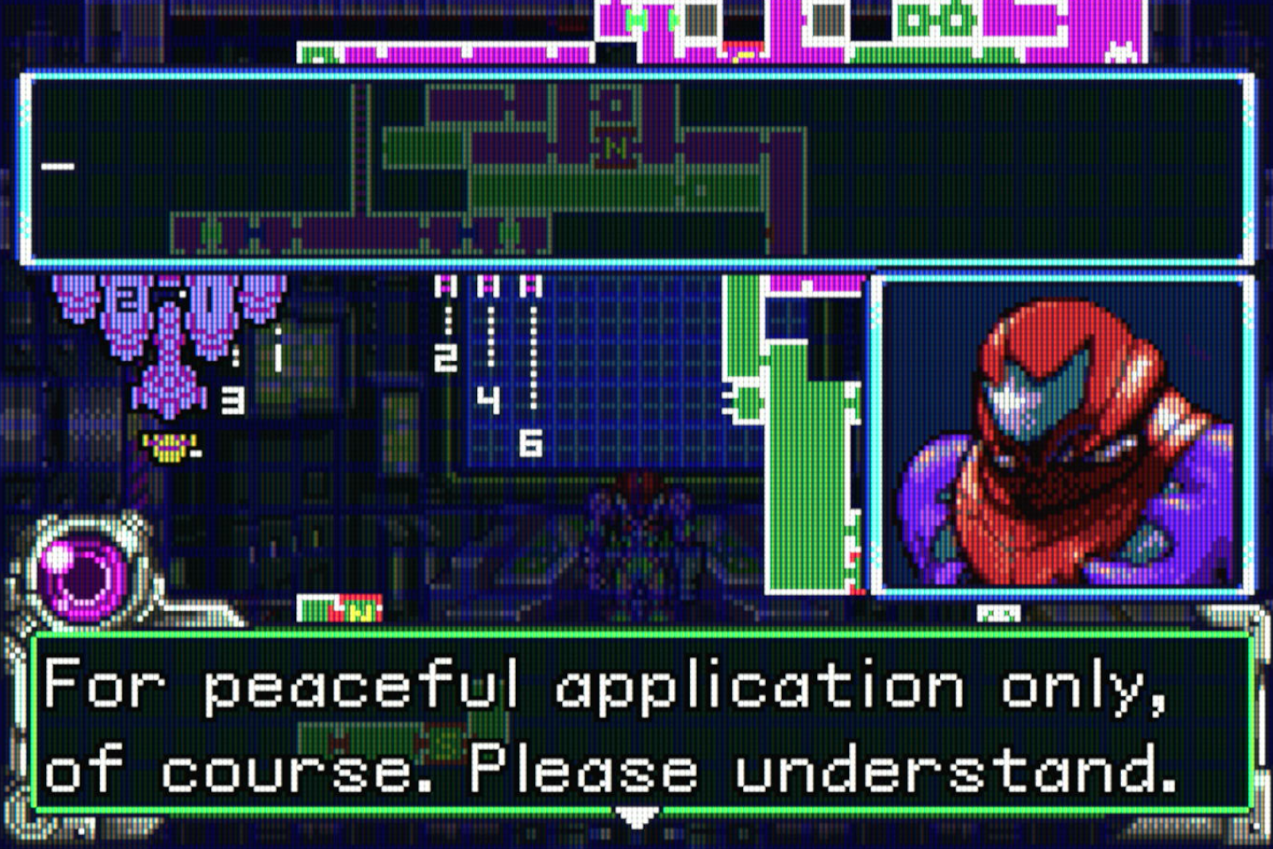
The Federation is just about the thematic opposite to Samus, only seeking to repeat the crimes they laid on the Space Pirates. Oh, so bioweapons are fine when the government does it, huh? This naturally coming to a head when you stumble into a highly restricted area where a Metroid cloning program was being kept, showing the real extent of the Federation's hypocrisy, especially as Adam says they're weaponizing Metroids "For peaceful applications, of course."
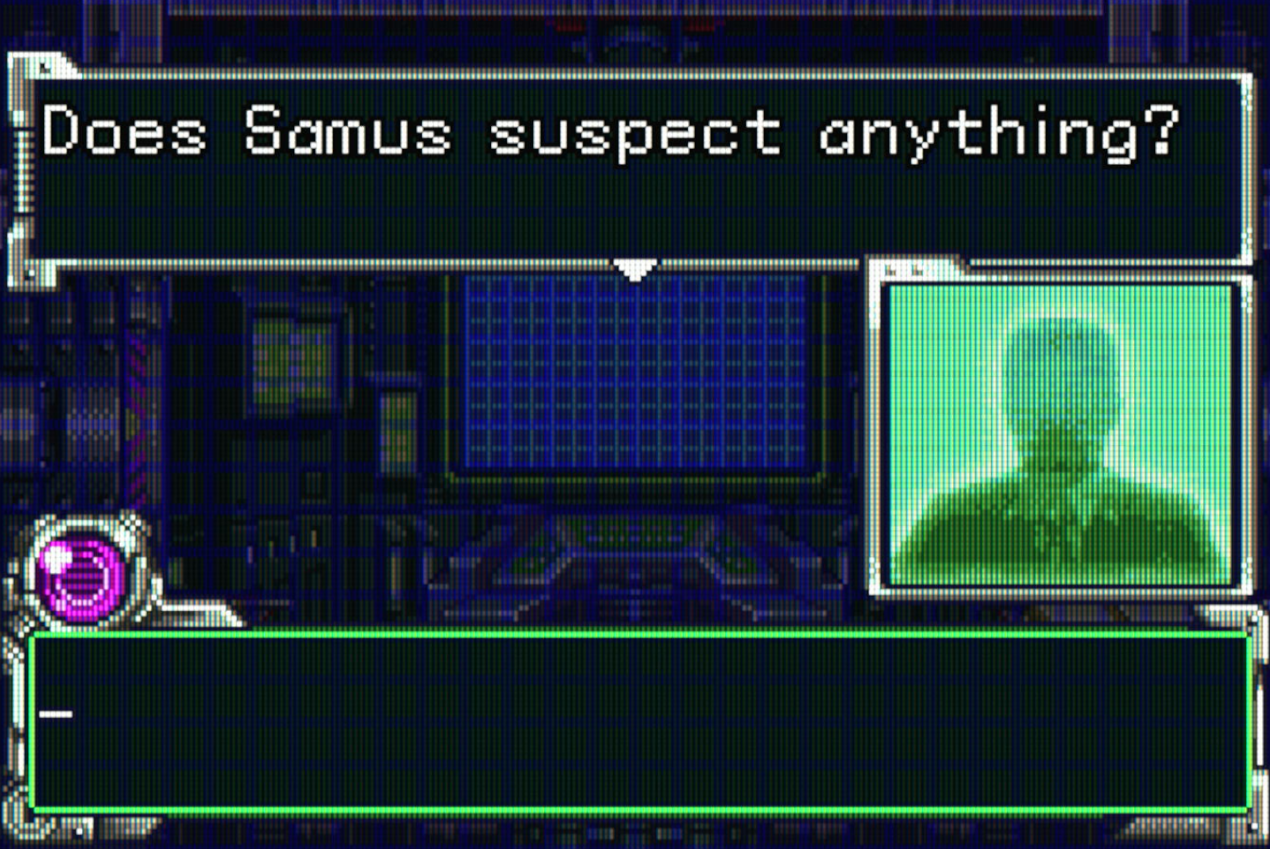
...This, feeling a bit patronizing when it plays a cutscene outside of Samus' perspective just to have a shady figure ask Adam if Samus "suspects anything", which feels like about as comically blunt as foreshadowing gets.
The Federation are even actively sabotaging Samus' progress and actively endangering her by withholding abilities she was supposed to obtain so that she wouldn't be able to kill the SA-X that they also wanted to research. A bit messed up! Samus coming to probably the only natural conclusion to all this news and deciding she wants to just blow the whole operation up. Something about a heartfelt admission to the AI that Samus had mentally nicknamed it after a former friend triggered a change of heart in AI-Adam, causing it to free Samus and give her instructions on how to best blow up not just the BSL, but also SR-388 with it.
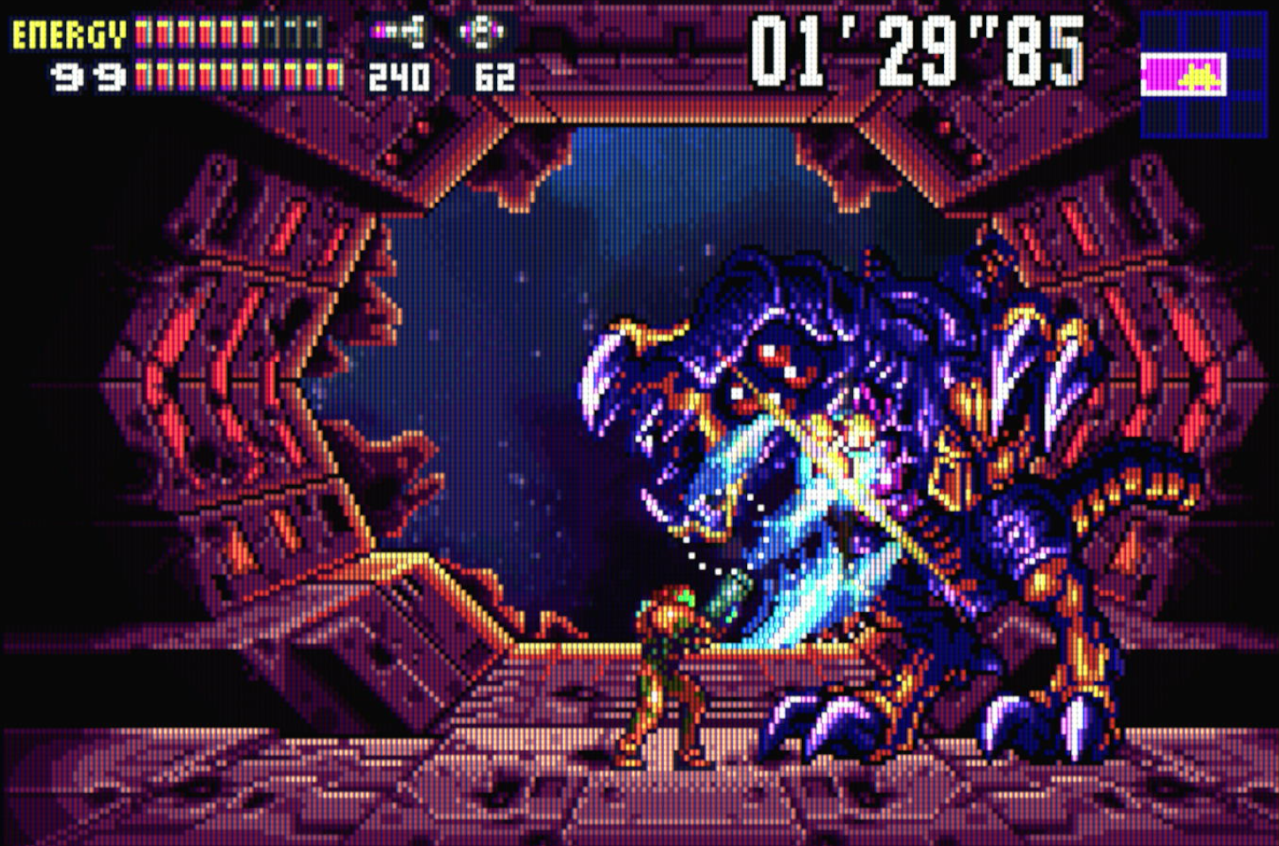
A couple kinda flaccid final confrontations later, Samus finally manages to absorb one of the SA-X, acquiring the Ice Beam which allows her to fight back against an Omega Metroid that made its way into the hangar during the escape sequence. One small shoutout to the environmental storytelling of this game, one of the ways the world changes is that, once you enter the Metroid hold and after the SA-X causing it to detach, you'll find shed Metroid skin lying around the SR-X area, much like how you'd see in Metroid 2, acting as foreshadowing that one of the Metroids managed to escape and fully grow up.
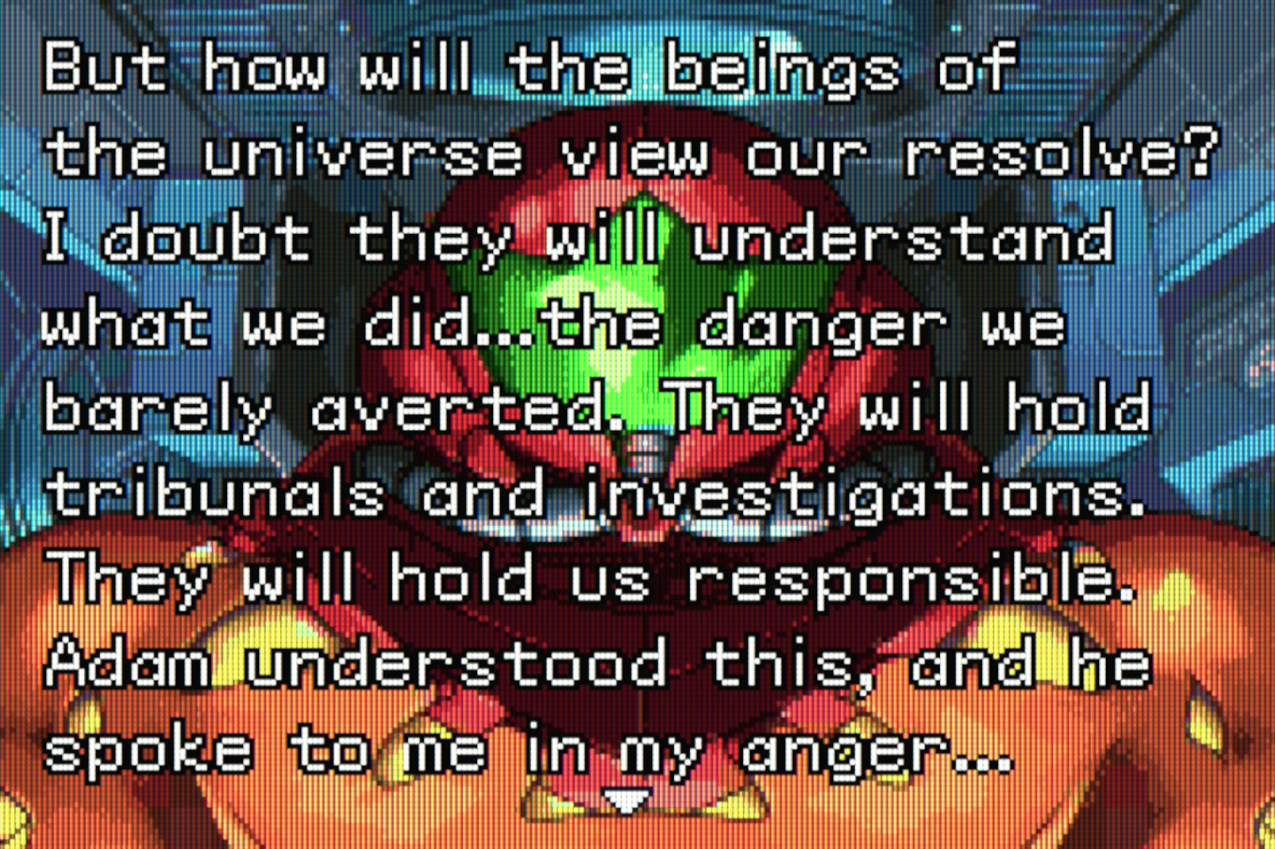
And in a last, ending monolog, Samus laments about her fate and how the Federation would take her taking matters into her own hands and eradicating all X life. Which only makes it stink more when it turns out, all this being the Federation's doing was a mistranslation by omission, as in the original Japanese script, it was explicitly a rogue faction of the Federation doing these sketchy things on the BSL. Which, I can't be alone in feeling like this defangs this story by a lot, right? It's still easily the best Metroid story so far in this series, but the English version of it that frames the Federation themselves as a hypocritical government that's willing to employ the very types of technology they deemed illegal just seems far FAR more interesting than the original Japanese version of these events. But I digress, I guess.
Oh yeah, and that AI that's been barking orders at you turns out to actually be the mind of the late Adam Malcovich, uploaded to a computer, as they apparently do with the mind of military leaders and scientists. So yay, reunion!
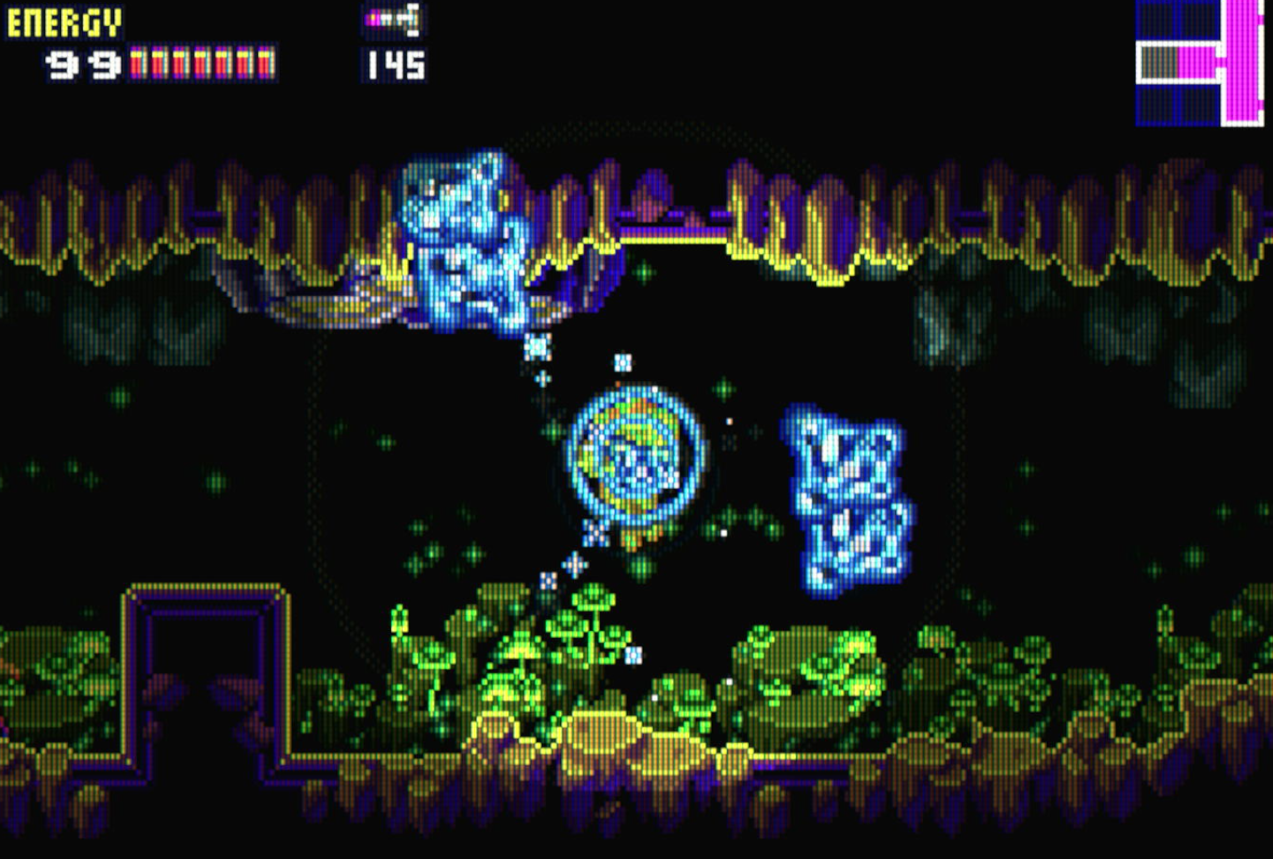
My relationship to Metroid Fusion is weird. I've once loved it just as much as Super Metroid, but while Super Metroid's remained unfaltering in its position as one of the best Metroid games, my enthusiasm for Fusion has sadly only lessoned with time. Feeling a bit like repeat playthroughs reveal more of its cracks over time, which is at least a little true for any game you replay over and over again, almost feels like it betrays the very genre and series its in, where I feel like replaying only enriches the experience with the game as you get more and more familiar with it. Or maybe that's part of its game as the anti-Metroid game.
I've complained a lot more in this review, but that's not because I dislike Fusion by any means, I still like it quite a bit, but my opinion on it has only gotten more nuanced over time. Which isn't necessarily a bad thing, I think it's certainly admirable to boldly do something weird with Metroid after an oft-regarded masterpiece like Super Metroid. There's no other Metroid game out there quite like it, in spite of how many future Metroid games try and copy its homework a bit. And maybe that's really what a series aught to do when it's hit what could very well be its peak.
-------------------------------------------------------
 VIXI SCORE: 8.5/10
It's admirably different, bold, and dares to not just copy obvious success, which I find admirable about it even if I don't always agree with its direction or think its direction is 100% effective. My first and second playthroughs were very enjoyable so it must be doing SOMETHING right.
 LUNA SCORE: 9/10
It does a lot right with the series, even if it isn't perfect! Similar sentiment that it doesn't quite hit the same highs as Super, but I still have fun with it.
 JINX SCORE: 9/10
very solid showing, does a lot of cool things to remix the metroid setting, i'm just not convinced with any of the horror angles I hear about it. still good in spite of that, though.
 IONO SCORE: 9/10
Now we're talkin! It's a little frustrating here and there, but the danger is cool. Makes me feel alive and stuff.
 CELESTE SCORE: 8/10
A little too high-strung and demanding for me, sorry. I still like it a lot! But it's just not got the right kind of friction for me.
 CHIAKI SCORE: 8.5/10
A flawed gem, but one that I still like a lot because it's at least doing something unique with the series. It's fun and tense, even if I feel like it seeps into annoying here and there. Especially with some of the optional puzzle rooms.
OVERALL SCORE: 52/60

Coming up next for The Last Metroid, we're going back to The First Metroid.